Introduction: The Classroom vs. The Kraken
In the controlled environment of a classroom or a research lab, machine learning often feels like a clean, mathematical exercise. Students and researchers are presented with curated datasets, and the primary challenge is selecting the right architecture or squeezing out an extra percentage of accuracy through hyperparameter tuning. In this academic setting, training data is a "cute little puppy"—predictable, manageable, and friendly. However, once you move from the lab to production, that puppy grows into a "Kraken". In the real world, data is messy, complex, and potentially treacherous. It doesn’t always fit into memory, it arrives malformatted, and its distributions shift without warning, capable of sinking your entire ML operation. This is where most models fail. While machine learning curricula are heavily skewed toward modelling, the actual success of an ML system depends on how well you can tame the data. The discrepancy between lab performance and production reality usually boils down to a fundamental misunderstanding of training data. Engineering a robust system requires moving beyond the "fun" part of building state-of-the-art models and confronting the "frustrating" and often "painful" reality of data engineering. The following five truths highlight why the data you curate is often more important than the code you write.
1. Your Features Matter More Than Your Algorithms
It is a common temptation to believe that a more complex model architecture is the key to better performance. Academics and researchers naturally prioritise modelling because it is intellectually stimulating and "fun". However, the "painful" work of data engineering—wrangling massive amounts of malformatted data—is what actually moves the needle in industry. Experience in the field suggests that simple algorithms become highly effective when paired with well-engineered features, whereas state-of-the-art models will fail if fed a weak signal. The importance of this shift in focus was famously highlighted in the 2014 paper Practical Lessons from Predicting Clicks on Ads at Facebook: "The most important thing in developing their ML models... having the right features tends to give them the biggest performance boost compared to clever algorithmic techniques such as hyperparameter tuning." From a systems perspective, the focus should not be on the "cleverness" of the maths, but on the strength of the signal. Identifying which attributes provide the strongest predictive power is the primary driver of success in production environments.
2. Hand-labelling is a bottleneck, not a gold standard.
Modern machine learning remains heavily dependent on supervised learning, which requires labels. While hand-labelling is often treated as the gold standard for ground truth, it is frequently the biggest bottleneck in a project's lifecycle. The difficulties of manual labelling are visceral, particularly when subject matter expertise is required. To classify spam, you can hire crowdsourced workers in minutes; to classify lung cancer from X-rays, you need board-certified radiologists whose time is limited and expensive. Beyond cost, other bottlenecks include:
-
Speed: Hand-labelling is incredibly slow. For example, phonetic-level transcription of speech can take 400 times longer than the actual utterance duration.
-
Privacy Risks: Shipping data to third-party annotators poses a threat to data privacy, as sensitive medical or financial records may be exposed.
-
Label Multiplicity: Experts often disagree. Disagreements among annotators are extremely common, making a single "ground truth" elusive. Andrej Karpathy, Director of AI at Tesla, reflected on the permanence of labelling in a talk to his students: 'When I decided to have an in-house labelling team, my recruiter asked how long he’d need this team for. He responded: 'How long do we need an engineering team?'" Because of these limitations, many teams are moving toward weak supervision. Instead of labelling by hand, they use Labelling Functions (LFs) — scripts that encode heuristics or domain expertise to programmatically label data at scale. This allows expertise to be versioned, reused, and applied to millions of samples instantly.
3. The Myth of Static Categories
A common mistake in ML design is assuming that categorical features—such as user IDs, brands, or product types—are static. In production, these categories are constantly evolving. Consider the scale of modern e-commerce: by 2019, Amazon already had over 2 million brands. If a model is trained to recognise a specific set of brands, it will inevitably crash or degrade when it encounters a new, "unknown" brand that wasn't in the training set. A counter-intuitive but highly effective solution to this evolving feature space is the Hashing Trick. Instead of maintaining an ever-growing vocabulary of every possible category, a hash function is used to map categories into a fixed-size space. While academics often consider this approach "hacky" and exclude it from curricula, it is a testimonial to industry effectiveness. Research from Booking.com shows that even a 50% collision rate (where two different categories share the same index) often results in a performance loss of less than 0.5%. This trade-off allows a model to remain stable even as its environment introduces millions of new features.
4. Data Leakage is a Subtle "Cheat Code"
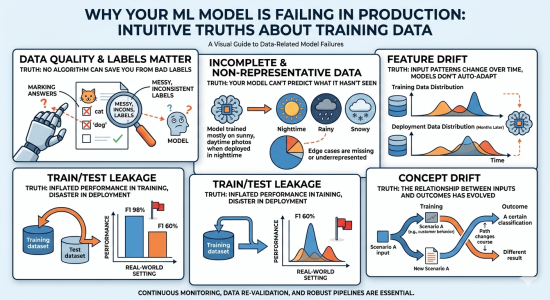
Data leakage occurs when information from the target label "leaks" into the features used for training. This creates a "cheat code" that allows the model to perform spectacularly well during validation, only to fail miserably in production when the label is no longer available. The danger of leakage is best illustrated by a cautionary tale from Kaggle: In the 2020 Ion Switching competition, the winning teams were those who realised they could reverse-engineer the synthesised test data to "peek" at the labels rather than actually solving the underlying physics problem. Common causes of leakage include:
-
Randomly splitting time-correlated data: This allows the model to "peek" into the future to predict the past.
-
Global Scaling: Calculating the mean or variance of the entire dataset before the split, leaking test set statistics into the training process.
-
Global Imputation: Filling missing values using statistics derived from the entire dataset. To detect these "cheat codes", a systems architect uses ablation studies — removing features one by one to see if performance drops realistically or catastrophically. If removing one seemingly minor feature causes accuracy to plummet from 99% to 60%, you’ve likely found a leak. Your primary defence is a strict temporal split. Always split your data by time first, and use statistics only from the training split to process your validation and test data.
5. The "Power Law" of Feature Importance
Not all features are created equal. Analysis of production models, such as those used by the Facebook Ads team, reveals a "power law" in feature importance. In many high-performing systems, the top 10 features account for roughly half of the total importance. Conversely, there is a "long tail" where the last 300 features contribute less than 1% of the total importance. As a systems architect, you must weigh the marginal utility of these tail features against their technical debt. Every added feature is a new point of failure for the pipeline that requires maintenance, code complexity, and monitoring. Furthermore, each additional feature:
-
Increases inference latency.
-
Increases the risk of data leakage.
-
Increases memory requirements for the serving infrastructure. Maintaining a lean, generalisable model by focusing on high-importance features often results in a more robust system than one that tries to utilise every available data point.
Conclusion: Moving Toward Data-Centric AI
The transition from a student of machine learning to a systems architect requires a shift in focus from "building models" to "curating data". The health of an ML system is determined less by the complexity of its code and more by the quality, sampling, and engineering of its training data. As you look at your next project, consider this: If your model’s success is 80% data and 20% code, why are you still spending 90% of your time on the code? Moving toward a data-centric approach isn't just about cleaning up a dataset; it's about treating data engineering as the core of the architectural process.
Reference:
Designing Machine Learning Systems: An Iterative Process for Production-Ready Application, O'Reilly Written by Chip Huyen