1. Introduction
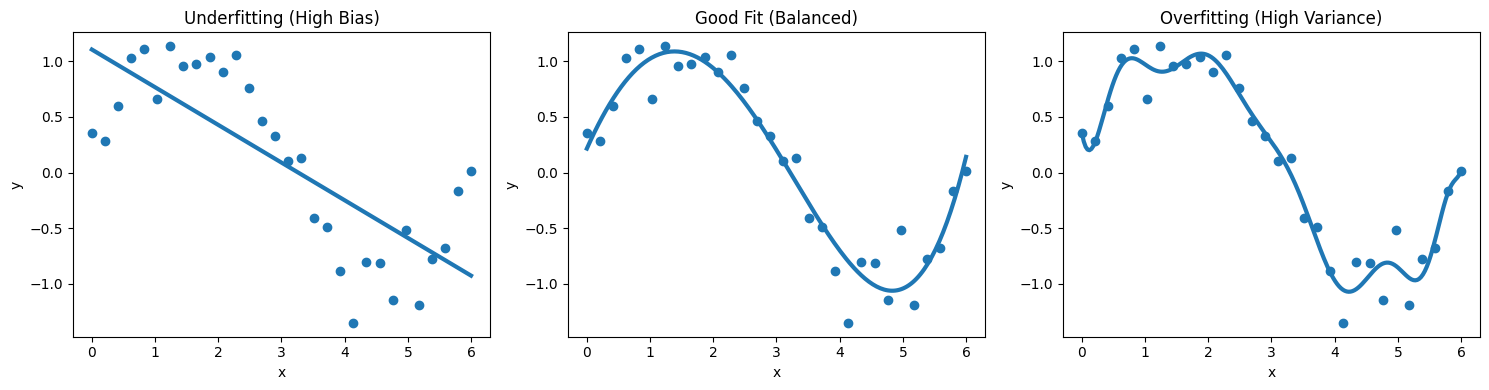
When we train a machine learning model, our goal is not just to perform well on the training data, but also to perform well on new unseen data.
A good model should generalize well.
However, two common problems occur during training:
- Underfitting
- Overfitting
Understanding these concepts is fundamental in Machine Learning because they determine whether a model can learn meaningful patterns from data.
2. Generalization
A model learns from training data and then makes predictions on new data. If the model performs well on both datasets, it has good generalization.
3. Underfitting
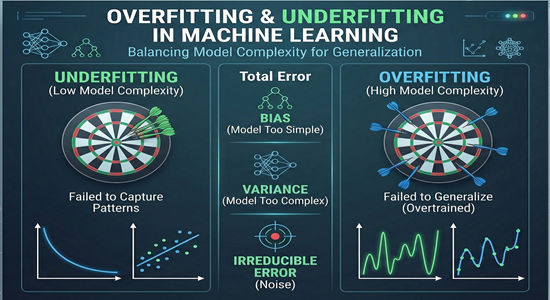
Underfitting occurs when a model is too simple to capture the underlying structure of the data. The model fails to learn the relationship between input variables and output variables.
Characteristics of the underfitting models show the following:
- High training error
- High testing error
- Poor predictions
- Inability to capture patterns
Example
Suppose we have nonlinear data. If we apply a simple linear model, it may not capture the true relationship.
For example:
Actual relationship:
But the model tries to learn:
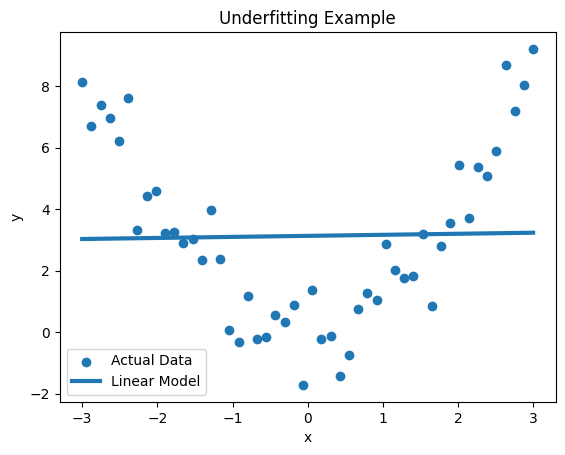
The model cannot represent the curved relationship.
Causes of Underfitting
Underfitting usually happens because:
- Model is too simple
- Not enough training time
- Important features are missing
- Excessive regularization
How to Fix Underfitting
Possible solutions:
- Use a more complex model
- Add more features
- Reduce regularization
- Train longer
4. Overfitting
Overfitting occurs when a model learns the training data too well, including noise and random fluctuations. Instead of learning general patterns, it memorizes the training dataset.
Characteristics overfitting models show:
- Very low training error
- High testing error
- Poor generalization
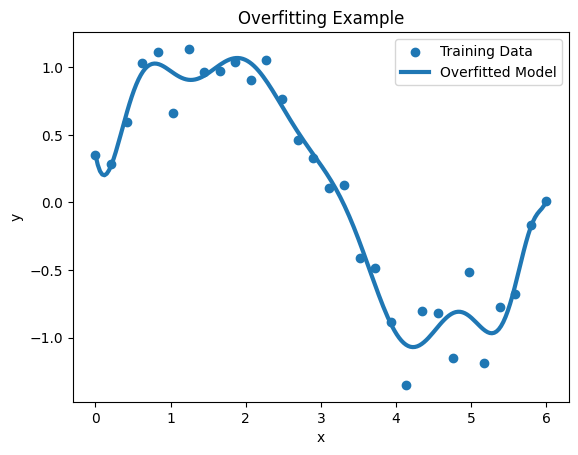
The model can perfectly match the training data. However, predictions on new data become unstable.
Causes of Overfitting
Overfitting occurs when:
- Model is too complex
- Dataset is small
- Too many features
- Training too long
- No regularization
5. Good Model Fit
he ideal situation lies between underfitting and overfitting. A good model:
- Captures the real pattern
- Ignores noise
- Performs well on new data
Intuitive Explanation
Think of a student preparing for an exam.
Two scenarios:
- Good learning
The student understands concepts and can solve new problems.
- Overfitting
The student memorises exact answers from past papers. When the exam changes slightly, the student fails. Similarly, an overfitted model memorises training data instead of learning patterns.